













Major Attractions and Highlights of the Manaslu Circuit Trek from Pokhara
- Ideal for beginners: The trek is highly recommended for people with no prior trekking experience who want to explore the Himalayan route on less crowded trails.
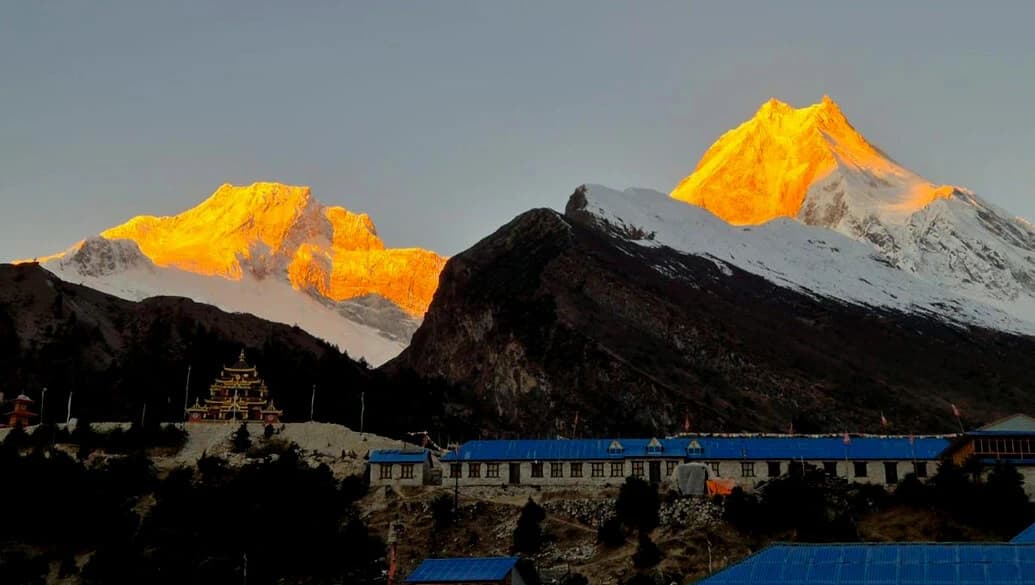
- Standing in the Shadow of Himalayan Giants: You will spend days trekking near Mt. Manaslu (8,163m), the world's eighth-highest mountain, and see its impressive views from many stunning spots along the way.
- The Larkya La Triumph: Crossing the Larkya La Pass (5,106m) is a big accomplishment and a rewarding experience. At the top, you’ll enjoy amazing views of peaks like Annapurna II, Gyaji Himal, and Himlung.
- A Tapestry of Dramatic Landscapes: The trail shows off a wide range of natural scenery. Each day, you’ll move from the dry high-altitude areas of Marsyangdi, through the rugged Nubri Valley, to the green valleys and waterfalls of Budhi Gandaki.
- Wildlife and Wilderness: As you trek through the Manaslu Conservation Area, you may spot rare Himalayan animals like Himalayan Thar, Snow Leopards, and Musk Deer in their natural environment.
- The Rugged Reality of the Trail: This trek gives you a real look at life in the Himalayas. You’ll cross areas with landslides and steep, narrow paths, and pass old glacial moraines. As you climb higher, the trails open up to wide, dramatic views of the mountains.
- Travel with the Budhi Gandaki: Much of the trek follows the Budhi Gandaki River, crossing it several times on suspension bridges above waterfalls and cliffs.
- Cultural Immersion: The trek follows an old salt trade route near the Tibet border. Along the way, you’ll meet Gurung, Ghale, and Shah communities in villages such as Sing La, Khorla Besi, Laprak, and Phillim.
- Connect with local spiritual heritage: You’ll see Tibetan Buddhism, Bhotia, and Bon traditions in action by visiting old monasteries, spinning prayer wheels, and walking past mani walls and stupas.
- Explore optional side trips: You can make your trek even more interesting by visiting places like Pungen Gompa (4,000m), Birendra Lake (3,700m), Manaslu Base Camp (4,800m), and Rui La Pass (4,998m) on the Tibet border.
11 Days Manaslu Trekking Package Overview from Pokhara
The 11 Days Manaslu Trek from Pokhara, unlike the standard package that starts in Kathmandu, is for travelers already in the lake city. This journey begins with a scenic drive from Pokhara towards Machha Khola (930 m/3,051 ft), the starting point. Your trek kicks off at a lower altitude and gradually ascends through charming villages such as Jagat, Deng, Namrung, and Sama Gaon.
The Manaslu Trek 11 Days is a high-altitude journey that encircles the 8th-highest mountain in the world, Mt. Manaslu (8,163m/26,781ft). Compared with the bustling trails of the Everest or Annapurna regions, the Manaslu trek is just as rewarding but less crowded. The journey strikes a perfect balance among rich cultural exploration, mountain solitude, and scenic beauty, making it genuinely exceptional.
Conquering Larkya La Pass: A surreal Achievement
Larkya La Pass, at 5,106 meters, is a high-altitude mountain crossing and one of the longest and most rewarding in the Nepalese Himalayas. It is physically demanding to reach Larkya La, but once you summit, you will feel victorious. To avoid strong winds and unforeseen weather changes, the trip to the summit usually starts before sunrise.
The trail requires both endurance and flexibility. You will hike through glaciers, rocky moraines, and, depending on the season, microspikes are required to navigate the trai. The ascent is gradual through an arid landscape at Larkya Phedi, where you will rest before moving further.
At the top of Larkya La Pass, you are rewarded with a 360-degree panorama of Himalayan giants. These include Mount Manaslu (8,163m), Himlung Himal, Cheo Himal, Kang Guru, and Annapurna II. Just below the pass, you will see spectacular views of the frozen Pongkar Tal lake. Unlike the ascent, the descent is easier. However, you must maintain careful footing on the trail to the beautiful alpine valley of Bimthang.
To ensure the adventurous trek to the pass is enjoyable rather than a constant struggle, we adhere to a strict safety commitment to ensure your well-being and consistency. Our guides will check your oxygen saturation and pulse rate with an oximeter daily, allowing us to assess whether you are adapting to the elevation.
Additionally, before the ascent, our team members will check that you are properly equipped with all necessary gear, including hiking boots with crampons, helmets, a torch, and layered clothing.
Trekking to the Manaslu Base Camp- What it’s Really Like
The Manaslu Base Camp Trek is an off-the-beaten-path trek that takes trekkers to a remote area of the Himalayas in Nepal and is also classified as a high-altitude trek because it travels through a restricted region of Nepal.
This trail goes along the steep valleys at the base of the world's 8th highest mountain, Mount Manaslu (8163 m/26781 ft). On this trek, trekkers will go through subtropical river valleys to the dry windy regions of Tibet; the whole experience of trekking to the base of Mt Manaslu is filled with pure silence.
You will find that all the villages and infrastructure along this trail have very few people, unlike many other well-known treks. The trails are very narrow, with the Budi Gandiki River roaring below, and there are many places where you walk through narrow gorges before coming out into broad alpine meadows.
This trek is a "raw" experience with many rocky and steep sections. As we get higher into the village of Samagaun, you will see many handmade woven clothes in the shops that showcase the culture and history of the people who live there.
Moving on, the trip will take you to ancient monastic sites such as Pungyen Gompa which has been built on a ridge line overlooking the expansive North Face of Manaslu Mountain. After visiting Pungyen, and Upper Samagaun you'll continue your trek up to Base Camp.
The view at base camp will blow your mind with huge glaciers all around you encircling the base camp, as well as these massive peaks like Himlung Himal and Kang Guru.
History and Cultural Background of the Manaslu Region
The Manaslu region of Nepal stayed hidden for decades until Toshio Imanishi and Gyalzen Norbu reached the summit in 1956. However, the trails nearby were mostly off-limits to foreigners until 1990. It was because the government restricted access due to security fears from the closed border with Tibet. This, in turn, brought a quiet blessing to the region.
It allowed the local ecology to remain stable and natural resources to stay intact, while more commercialized routes in Nepal began to feel the strain of increased travelers. Trekking in these parts has a long history. There were only 300 trekkers in 1995. The big change came when teahouses were built in 2010, making it possible for more people to trek without having to camp the whole way.
After the earthquake, 2288 tourists came to the region, which is a strong indicator of how resilient the area is. Since then, there has been consistent growth, with over 7000 trekkers per year since 2018. What trekkers are looking for now is what the years of restrictions have protected; a deep sense of solitude.
On the Manaslu Circuit, it is still common to walk for hours without encountering another group, giving you the space to actually hear the wind through the pines and the roar of the Budhi Gandaki. The visual backdrop is equally striking, with the pyramidal mass of Mt. Manaslu dominating a skyline shared with Himlung Himal and Ganesh Himal.
The villages are traditional. Commercialisation started late and didn't have the same impact as it did elsewhere. The Nubri and Tsum people continue to practice many of their traditions on a daily basis. Because of this, trekking in Manaslu gives trekkers a real human connection to pristine nature, untouched landscapes, and centuries-old culture.
Cultural Experience on the Trail
The Manaslu Circuit provides an outdoor museum for people to experience Tibetan Buddhist heritage. Hiking this trail will transport you back in time. You will see people spinning prayer wheels and hanging lungta (prayer flags) along the mountain trail as you hike. The Manaslu Circuit not only provides an opportunity to hike but leads you to Beyul Kyimolung, a sacred valley that has retained its traditional practices and culture without the influence of modernity.
Iconic Monasteries and Spiritual Hubs
The pathway leads visitors toward several landmarks with religious significance, including Lokpa - a village thought to have been blessed centuries ago by the Buddhist teacher Padmashamva. Other religious sites along this trail include Shringi Gompa in the Bihi area and two separate monasteries called Mu and Rachen Gompas located within the Chhekampar region. Additional cultural highlights include the Tsumba people and their architecture and culture include reflected in sites like Panago Gompa, Mani Dhungyur Temple, and Gurwa.
Mu Gompa: This is the oldest (i.e., established in 1895) and largest monastery in Tsumyang. It contains many sacred books (Kangyur) consisting of Buddhist text, as well as a huge statue of Avalokiteśvara.
Dephyudonma Monastery: Tucked against a rugged mountain backdrop, this is one of Tsum Valley’s oldest sites. It is still run by a traditional Lama and is considered the cradle of Buddhism in this high-altitude wilderness.
Rachen Gompa: The sacred site was established in 1905 and reflects the beauty of Himalayan culture through its stunning artistic majesty. The nunnery of Rachen Gompa houses stunning murals on the interior walls which convey the historical development of Buddhism through time and space; thus providing the visitor with a peaceful and meditative environment.
The Sacred Piren Phu Cave
Near Burji village, tucked under a towering cliff, lies Piren Phu (The Pigeon Cave). This is one of the most significant pilgrimage sites on the trek. The legendary Tibetan yogi, Milarepa, is said to have meditated here, leaving a footprint in the rock as a testament to his spiritual power.
The site comprises two monasteries that have been built into the side of a cliff. Both monasteries are decorated with brilliant Buddhist murals and ancient stone inscriptions that demonstrate the legacy of an earlier epoch of history. The long strings of prayer flags flapping in the wind and the traditional paper documents contained within the rooms make Piren Phu a continuing live museum and memory of Manaslu.
11 Days Manaslu Circuit Trek Location, Distance, and Attitude
The 11 Days Manaslu Circuit Trek is located in Nepal’s northern Gorkha district, close to the rugged borderlands of Tibet. The trek runs through the Manaslu Conservation Area, which encompasses the Budhi Gandaki River valley, where the trekker climbs through low farming areas into high alpine valleys.
As trekkers continue north, they will go from an area of bamboo and pine forest to one of glaciers and steep rock, and they will also witness that the communities at the higher elevations have an entirely different Tibetan influence in their building design and spiritual culture.
The trek from Pokhara to Machha Khola to Dharapani is 150 km, consisting of 11 days. Of the 11 days, there are 9 days for active trekking and 2 additional days needed for the round trip by road to the trailheads. The trail starts at Machha Kholato, at an elevation of 890 m, and ascends to the Larkya La Pass, the highest altitude of 5,106 m.66
During the journey, trekkers will acclimatize in villages such as Namrung (2,630m) and Sama Gaon (3,530m) before reaching high camp. This slow-and-steady approach is vital for successfully navigating the Larkya La Pass, the highest and most demanding point of the journey.
How to Get to the Manaslu Circuit Trek Starting Point from Pokhara?
Getting to the trailhead from Pokhara is a bit of an adventure itself, and you essentially have two choices:
Taking the Public Bus: If you’re on a budget, head to Prithvi Chowk. Buses leave from the bus park roughly every 20 minutes. You won’t find a direct bus to Machha Khola or Jagat, so you need to board the first one for Arughat, Dhading; this section of the road is primarily on a major highway and takes around 6 hours and costs approximately 1,000 NPR. After reaching Arughat, transfer to a new bus for the last stretch of the trip. It takes approximately four hours to reach the final destination, and the road is bumpy. The cost for the final leg of the trip is around 4000 NPR. This is a total of 10 hours of travel, so take some snacks with you, however, we manage your itinerary with a private jeep from Pokhara to Machha Khola, because there are many places stop, and it takes a long time.
Renting a Private Vehicle: For a faster and much more comfortable trip, most people rent a 4WD like a Scorpio or a heavy-duty SUV. The drive to Arughat is smooth and paved, but the road from Arughat to Machha Khola is another story; it’s unpaved and can get very bumpy, so you really need the extra clearance of a 4WD. This cuts your travel time down significantly, and it’s about four hours to Arughat and just two more to reach the trailhead. If you are interested to come back by a private jeep from Dharapani to Kathmandu/Pokhara than it costs between 215 USD, including all logistics for the ride.
Cost of the Manaslu Circuit Trek from Pokhara
The price of the 11 Days Manaslu Circuit Trek package ranges from $875 to $1297 USD. As you are already in Pokhara, it’s comparatively cheaper than from Kathmandu because you'll save on accommodation and transportation.
However, you should also know that the overall cost will vary depending on factors such as group size, season, facilities, and services included. In general, the standard package will cover permits, guide and porter fees, accommodation, meals, and transportation.